By the end of 2020, China's cumulative installed wind power capacity reached 281 million kilowatts, including 271 million kilowatts of onshore wind power and approximately 9 million kilowatts of offshore wind power. This has made China the veritable world leader in wind power — 130% more than the United States, which ranks second, and 1.2 times the total installed capacity of Europe as a whole.However, in terms of the proportion of wind power in total electricity demand, China currently not only lags behind European and American countries but is also slightly below the global average.

The year 2020 was also a remarkable year for global climate action. We witnessed not only commitments to achieving carbon neutrality by 2050 from economies such as the European Union, Japan, South Korea, Canada, and South Africa, but also a solemn declaration made by Chinese President Xi Jinping to the international community at the General Debate of the 75th Session of the United Nations General Assembly: China will strive to peak carbon dioxide emissions before 2030 and achieve carbon neutrality before 2060. As the world's second-largest economy and the largest carbon dioxide emitter, China's commitment is regarded as the most important milestone in humanity's response to climate change since the Paris Climate Agreement was reached in 2015.
In 2021, the global journey of combating climate change continued to make breakthroughs. Earlier this year, newly inaugurated President Biden announced the United States' return to the Paris Agreement. In April, at the Leaders Summit on Climate convened by the U.S., more than 40 national leaders, including Chinese President Xi Jinping, reaffirmed or updated their respective emission reduction targets. On behalf of the United States, Biden pledged to reduce greenhouse gas emissions by 50–52% below 2005 levels by 2030 and achieve carbon neutrality by 2050. Additionally, the President of Brazil also announced at the summit that Brazil would join the 2050 carbon neutrality coalition. According to the latest statistics from the International Energy Agency (IEA), as of April this year, 44 countries and the European Union have made carbon neutrality commitments, representing approximately 70% of global carbon dioxide emissions and GDP. Clearly, the era of fossil fuels represented by oil and gas will soon come to an end, and the global energy transition centered on new energy will be unstoppable. In its Net Zero by 2050: A Roadmap for the Global Energy Sector report released in May this year, the IEA predicts that wind power and solar PV will supply approximately 70% of global electricity demand by 2050. To achieve this goal, the IEA calls in the report for the pace of global wind and solar PV installation to accelerate further over the next decade — annual new wind power installations must reach 390 GW by 2030 and remain at a level of 350 GW by 2050.
Data shows that driven by the carbon neutrality trend, global wind power deployment is accelerating. According to the latest statistics from GWEC, the total global wind power awarded capacity in the first quarter of 2021 reached 6,970 MW, 1.6 times that of the same period last year. Meanwhile, the scale of wind power project tenders announced in the first quarter also increased synchronously, with a total volume exceeding 14 GW. These two sets of data not only demonstrate the resilience of the wind power industry during the COVID-19 pandemic but also show that wind power is becoming an important engine for green economic recovery in various countries.
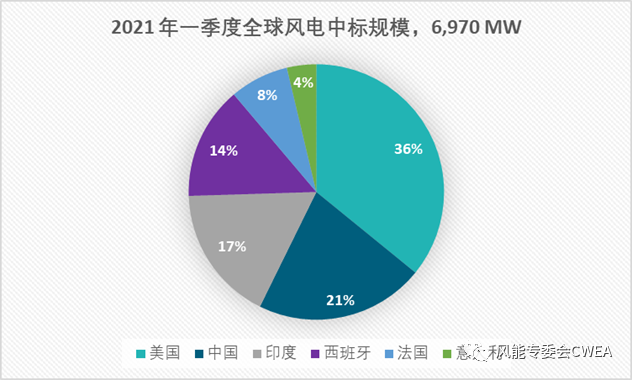
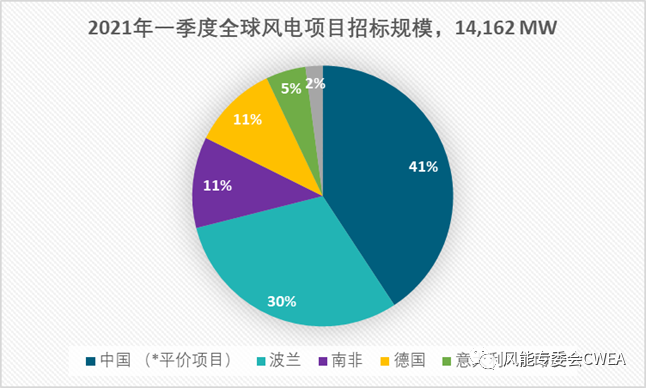
Data Source:GWEC,2021
At the end of December 2020, the U.S. Senate passed the Consolidated Appropriations Act and COVID-19 Relief Bill, which included a one-year extension of the Production Tax Credit (PTC), ensuring the steady development of the onshore wind power market through 2025. At the same time, the bill also extended the offshore wind Investment Tax Credit (ITC) through the end of 2025, undoubtedly providing the most crucial support for the U.S. offshore wind power market, which is still in its "infancy." This policy has not only boosted investment confidence among both overseas and domestic developers but also paved the way for building a domestic offshore wind power supply chain. To rapidly launch the offshore wind power market and create local jobs, the Biden administration set a target of 30 GW of offshore wind capacity by 2030 in March this year, which will lay the foundation for the U.S. to reach 110 GW of offshore wind capacity by 2050. Addressing the severe delays in project approval that offshore wind faced during the Trump administration, the new government has specifically authorized the Bureau of Ocean Energy Management (BOEM) under the Department of the Interior to accelerate offshore wind project approvals. In February this year, the Vineyard Wind offshore project (800 MW), which had previously withdrawn its construction permit application, restarted the application process and received federal approval in May. This project is not only the first large-scale commercial offshore wind project approved in the United States but also marks the true launch of the U.S. offshore wind market. Furthermore, according to the latest statistics from the Lawrence Berkeley National Laboratory, as of the end of May this year, wind power projects with a total capacity of 209 GW are queuing up in the U.S. to apply for grid interconnection permits, of which nearly 30% are offshore wind projects.
This article is republished on the Nenggao Pukang official website for the purpose of conveying more information. It does not represent endorsement of its views or confirmation of its description. The content is for reference only. There is no commercial use involved. If there is any infringement, please contact us for removal.